

Can a Menu Item Be Trademarked?

Showing Trademark Use for Food Products vs Restaurant Services
Restaurant owners often ask an important question when building their brand:
Can a menu item itself be trademarked?
The answer depends on how the name is used and what it actually identifies.
In many cases, restaurant owners attempt to trademark the name of a dish, beverage, or specialty item without understanding that trademark law protects brand identifiers, not simply menu descriptions.
A name that functions as the brand of a product may qualify for trademark protection. But a name that merely describes a food item on a menu usually does not.
Understanding this distinction is critical when filing a trademark application with the United States Patent and Trademark Office (USPTO). Improper classification or weak specimen evidence frequently results in refusals or Office Actions.
This guide explains:
- The difference between obtaining trademark registration of a menu item vs restaurant services
- When a food name functions as a trademark
- Specimens for packaged food products
- Specimens for branded menu offerings
- Product branding vs descriptive food names
- Common refusal reasons for menu item trademarks
- Strategic considerations for restaurants expanding into retail food sales
If you have not reviewed the broader legal framework yet, start with our foundational guide: What Qualifies as Trademark Use in Commerce? Real Specimen Examples by Industry.
Restaurant Services vs Food Product Trademarks
Restaurants typically register trademarks for services, not goods.
Most restaurant businesses file in International Class 043, which covers:
- Restaurant services
- Bar services
- Café services
- Catering services
- Food truck services
In these cases, the trademark identifies the restaurant itself, not the food items served.
Example
A restaurant called “ShishGrill” uses that name to identify the restaurant business.
Acceptable specimens might include:
- Storefront signage
- Menus displaying the restaurant name
- Website pages promoting the restaurant
- Online ordering platforms
The USPTO accepted this as evidence of use of the trademark SHISH GRILL for restaurant services in Class 043. The specimen shows the trademark as signage outside the restaurant.
These show the mark functioning as a service mark.
This concept is explained in greater detail in the previous article in this series:
How Restaurants and Food Trucks Prove Trademark Use in Commerce.
When a Menu Item Name May Function as a Trademark
A menu item name may qualify for trademark protection only if it functions as a brand identifying the source of the product, rather than simply describing a dish.
Most menu items are descriptive or generic, such as:
- Chicken sandwich
- Spicy ramen
- Chocolate cake
These names typically cannot function as trademarks.
However, a distinctive name used consistently as branding may qualify.
Example
Possible trademark-style menu names:
- “Big Mac”
- “Whopper”
- “Crunchwrap Supreme”
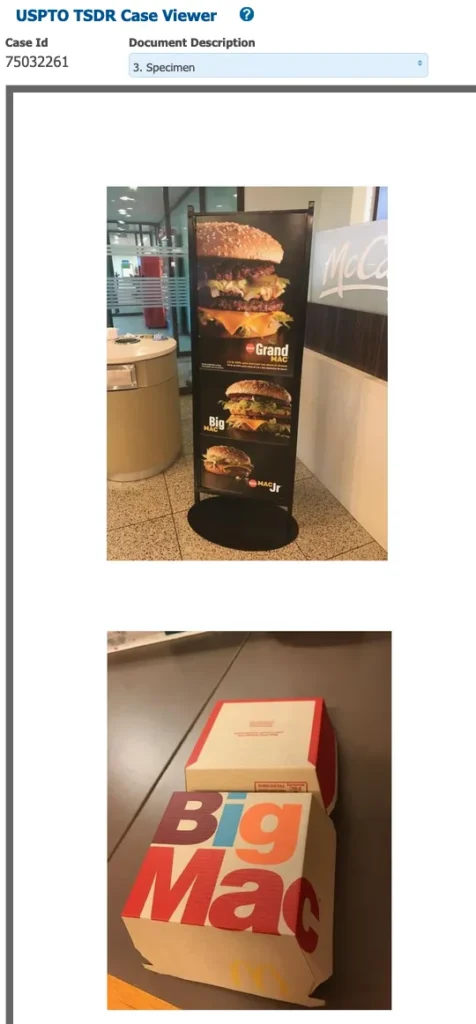
The USPTO accepted this specimen as evidence of use for the trademark “BIG MAC” for hamburger sandwiches.
In these situations, the name identifies a specific branded product associated with a particular company.
Consumers understand that the product comes from a particular source.
Without this association, the USPTO may determine that the wording is simply descriptive or informational, not a trademark.
Specimens for Packaged Food Products
If a restaurant sells physical food products, the trademark may apply to goods, not services.
Common examples include:
- Bottled sauces
- Packaged spice blends
- Frozen meals
- Coffee beans
- Packaged desserts
These goods are usually classified in food-related trademark classes, such as:
- Class 029 (meat, prepared foods)
- Class 030 (coffee, sauces, baked goods)
- Class 032 (non-alcoholic beverages)
To prove trademark use for goods, the mark must appear:
- On the product itself
- On packaging
- On labels
- On displays associated with the sale of goods
Acceptable specimens may include:
- Product packaging showing the mark
- Bottle labels
- Retail shelf displays
- Website ordering pages for packaged food
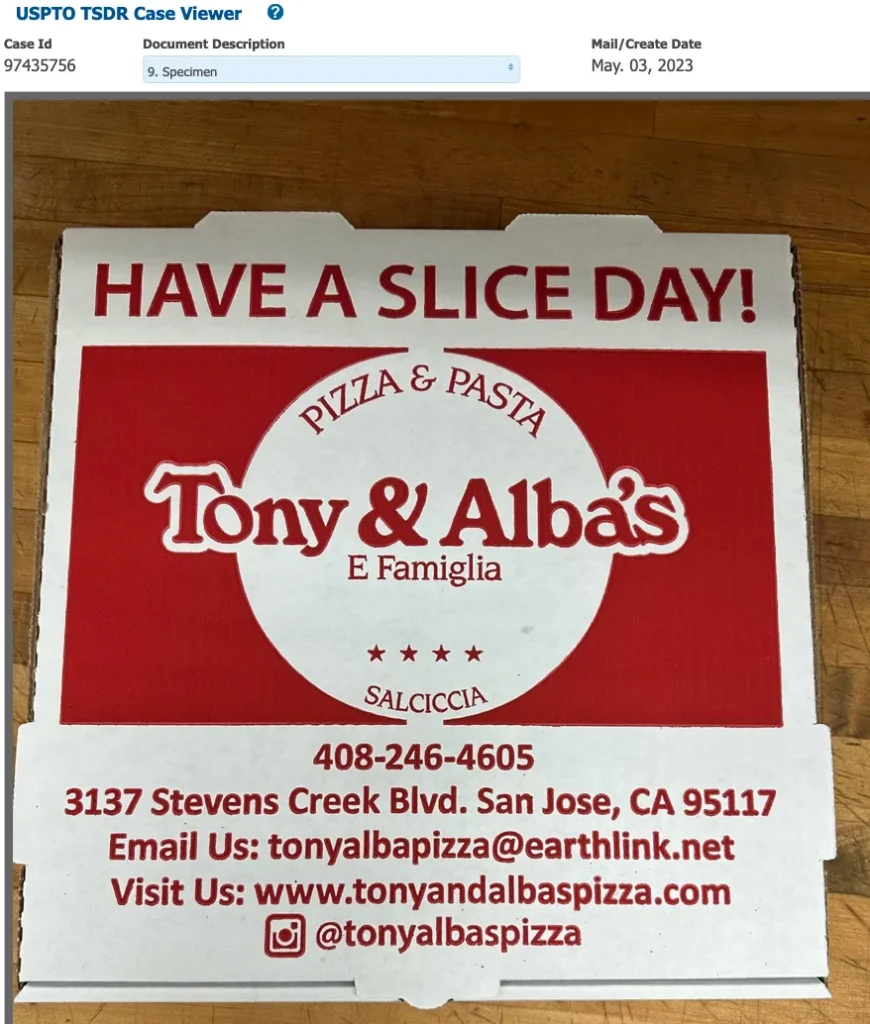
The USPTO accepted this specimen as evidence of use for pizza in Class 030 for the trademark “HAVE A SLICE DAY”. The trademark is clearly shown on packaging for the food product.
The key requirement is that the trademark clearly identifies the source of the product.
This differs from restaurant service marks, where advertising may be sufficient.
Specimens for Branded Menu Offerings
Sometimes a restaurant attempts to trademark a specific menu item without selling the product separately.
In these situations, the USPTO may accept certain types of evidence.
Possible specimens include:
Menus displaying the branded item
A menu listing a distinctive item name prominently may demonstrate trademark use if the wording functions as branding.
Example:
A menu item called:
“Zingers Melt®”
If the name appears consistently and prominently as a branded offering, the USPTO may accept the menu as evidence of trademark use.
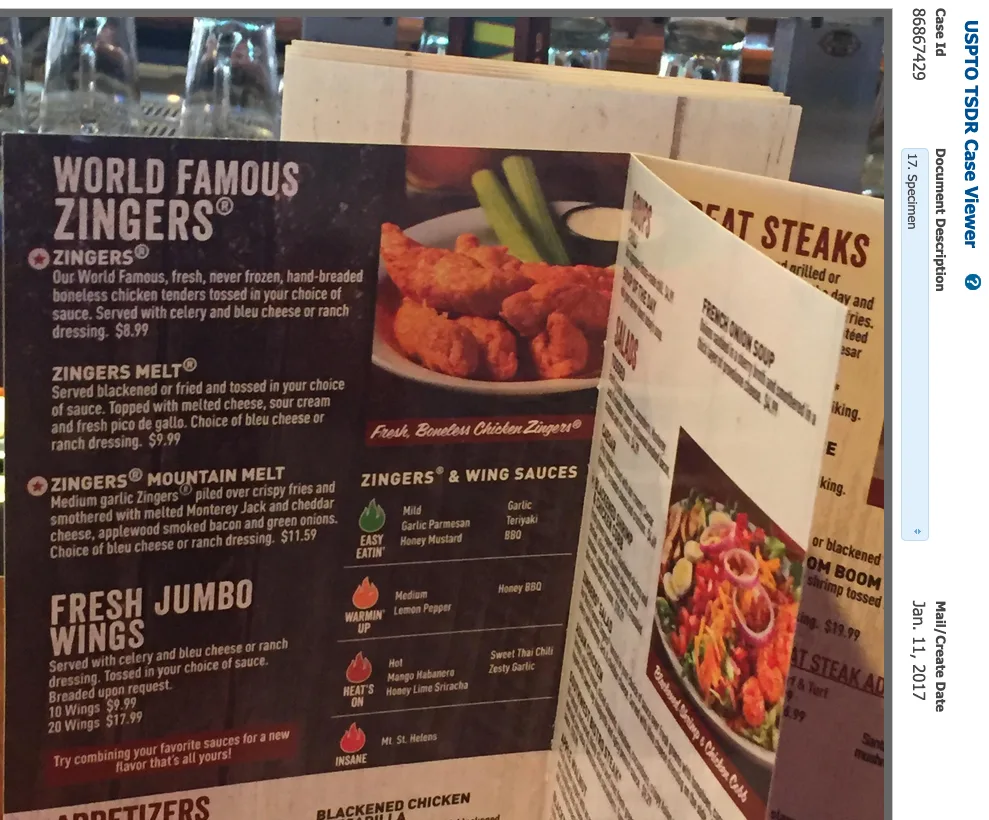
The USPTO accepted this specimen as evidence of use a menu item, namely chicken tenders in Class 029 for the trademark ZINGERS MELT. The trademark is shown with a description of the product on a menu.
Website ordering pages
Online ordering systems showing:
- The item name
- The restaurant branding
- Ordering functionality
These may serve as acceptable specimens.
However, the USPTO closely examines whether the wording actually functions as a trademark.
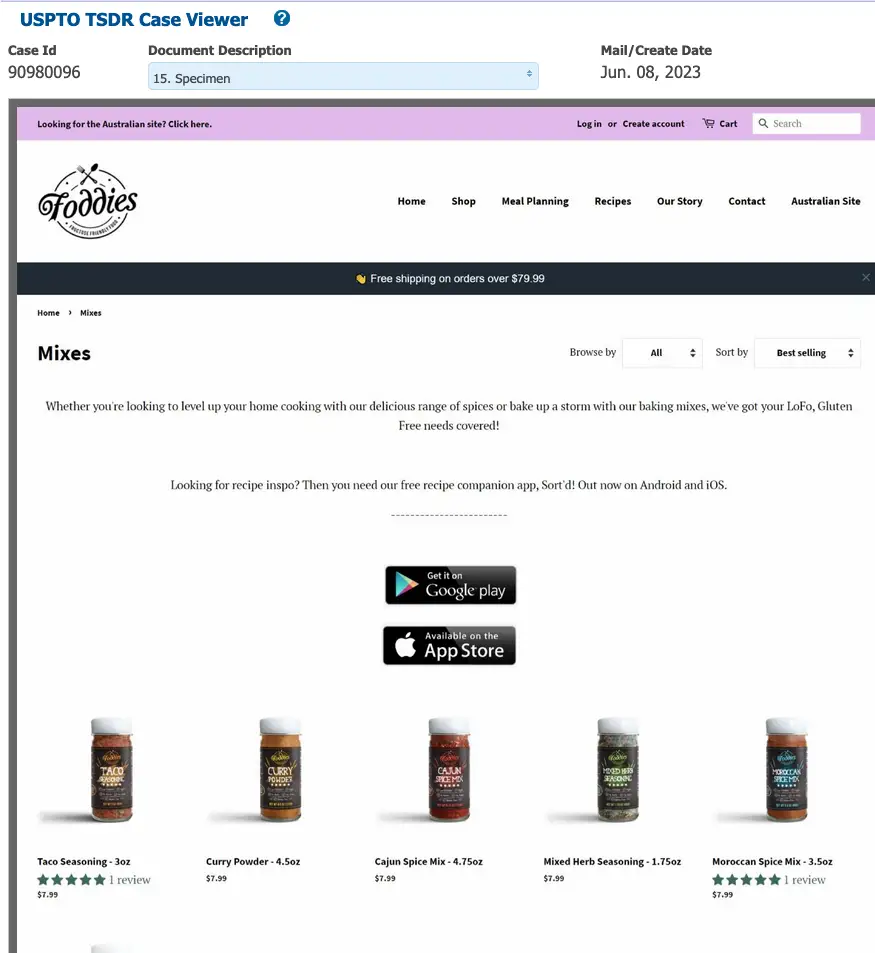
The USPTO accepted this specimen as evidence of use for online food retail store services for the trademark FODDIES FRUCTOSE FRIENDLY FOOD in Class 035. The specimen shows the trademark on a website showing food products along with a way to place an order for a food product.
Product Branding vs Descriptive Food Names
This distinction is one of the most common sources of refusal.
Descriptive Names
Names that merely describe the food are usually not registrable.
Examples:
- Spicy Chicken Sandwich
- Vegan Burrito Bowl
- Classic Cheesecake
These names simply tell customers what the item is.
Branded Product Names
A unique or distinctive name that identifies the source may qualify.
Examples might include:
- “Dragon Fire Tacos”
- “Midnight Mocha Blast”
- “Firecracker Fries”
Even then, the USPTO may evaluate whether the wording functions as a trademark or merely as a menu description.
Distinctiveness plays an important role in trademark protection.
Restaurants considering trademark protection for menu items should evaluate whether the name is truly brandable.
Common Refusal Reasons for Menu Item Trademarks
The USPTO frequently refuses trademark applications involving food items for several reasons.
Generic or Descriptive Wording
If the name simply describes the food item, the USPTO may issue a refusal.
Failure to Function as a Trademark
If the wording appears merely as a menu description rather than branding.
Lack of Proper Specimen
Applicants sometimes submit:
- Food photos with no branding
- Menus where the item name appears generically
- Marketing materials that do not show trademark use
These may fail to demonstrate that the wording functions as a trademark.
Incorrect Classification
Some applicants mistakenly file menu item names under restaurant services rather than goods.
Proper classification depends on how the mark is used.
Limited Evidence of Source Identification
If consumers would not recognize the name as identifying a product from a specific source, registration may be refused.
Strategic Considerations for Restaurants Expanding Into Retail Products
Many successful restaurants eventually expand into retail food products.
Examples include:
- Selling bottled sauces
- Retail coffee products
- Packaged desserts
- Frozen meal lines
In these situations, the trademark strategy may need to expand beyond restaurant services.
A restaurant may hold trademarks in multiple classes, such as:
- Class 043 for restaurant services
- Class 030 for packaged sauces or baked goods
- Class 029 for prepared foods
Separate specimens must be provided for each class.
For example:
A café might register its brand for:
- Café services
- Packaged coffee beans sold online
Each requires separate evidence of trademark use.
Planning trademark protection early can simplify future brand expansion.
Final Thoughts
Not every menu item name qualifies for trademark protection.To be registrable, the name must function as a source identifier, not simply describe a dish.
Restaurant owners considering trademark protection for food products should evaluate:
- Whether the name is distinctive
- Whether the mark identifies a product brand
- Whether proper specimen evidence exists
- Whether the correct trademark class is selected
Understanding the distinction between restaurant services and food product branding can prevent costly filing mistakes.
Businesses expanding into packaged food products should carefully plan their trademark strategy to ensure their brand remains protected across both services and goods.
Frequently Asked Questions (FAQ)
Can a menu item name be trademarked?
Sometimes. A menu item name may qualify if it functions as a brand identifying the source of the product rather than merely describing the dish.
Are menus acceptable trademark specimens?
Yes. A menu may serve as evidence of use if the wording functions as a trademark identifying the product or service.
Can restaurants trademark their signature dishes?
Can restaurants trademark their signature dishes?
In some cases, yes. The name must be distinctive and used as branding rather than simply describing the food.
What if a restaurant later sells packaged versions of a menu item?
The trademark application may need to include additional classes covering physical goods, and new specimens showing use on packaging or labels.
Why are many menu item trademarks refused?
Common reasons include descriptive wording, lack of distinctiveness, improper specimens, or failure to show that the wording functions as a trademark.

“Disclaimer: This blog post is provided by Adams Law Office for educational and informational purposes only. It is intended to offer a general overview and understanding of trademark law and related topics, not specific legal advice. The content reflects the state of the law at the time it was written and may not reflect subsequent legal developments. This material should not be used as a substitute for professional legal counsel tailored to your individual situation. For personalized legal guidance, please consult a licensed attorney.”