

How Restaurants and Food Trucks Prove Trademark Use in Commerce: Acceptable Specimen Examples

For restaurant owners, proving trademark specimens for restaurants and proper trademark use in commerce may be more nuanced than it appears. Unlike apparel brands or software companies, restaurants typically apply for service marks, not trademarks for goods. That distinction affects what qualifies as acceptable proof of use and what the United States Patent and Trademark Office (USPTO) will reject.
Unlike apparel brands or software companies, restaurants typically apply for service marks, not trademarks for goods. That distinction affects what qualifies as acceptable proof of use and what the United States Patent and Trademark Office (USPTO) will reject.
This guide explains:
- How service mark use works for restaurants and food trucks
- Acceptable specimens (menus, signage, websites, ordering platforms)
- Physical location vs online ordering proof
- Delivery apps and third-party platforms as evidence
- The difference between restaurant name branding and food product branding
- Common filing mistakes
- Evidence strategies for multi-location businesses
If you are unfamiliar with the broader legal standard for “use in commerce,” review our foundational guide first: What Qualifies as Trademark Use in Commerce? Real Specimen Examples by Industry
Service Mark Use for Restaurant Businesses
Restaurants, including food trucks, typically file in International Class 043, which covers:
- Restaurant services
- Bar services
- Catering services
- Take-out services
- Mobile trucks providing food and drink
Because restaurants provide services, not goods, the legal standard differs from product-based businesses.
What Must Be Shown?
To prove use in commerce for restaurant services, the mark must:
- Be used in the sale or advertising of restaurant services
- Be clearly associated with the services
- Be used in interstate commerce
Unlike goods, advertising can qualify, but the restaurant must actually be offering services, not just announcing a future opening.
Acceptable Specimens for Restaurants
Below are the most commonly accepted specimen types for Class 043.
Signage
Photographs of:
- Storefront signs
- Building signage
- Interior signage at point-of-sale
These work well when they clearly show:
- The restaurant name
- The physical location
- Evidence that customers can purchase food
Some examples of acceptable evidence of use for restaurant services are shown below.
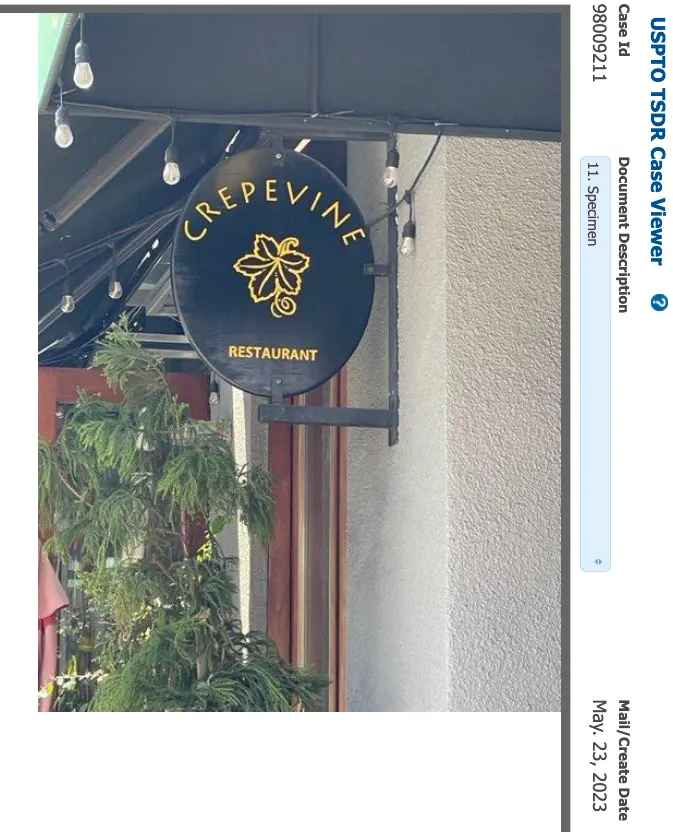
Photo of exterior signage showing use of the trademark CREPEVINE and logo for restaurant services.
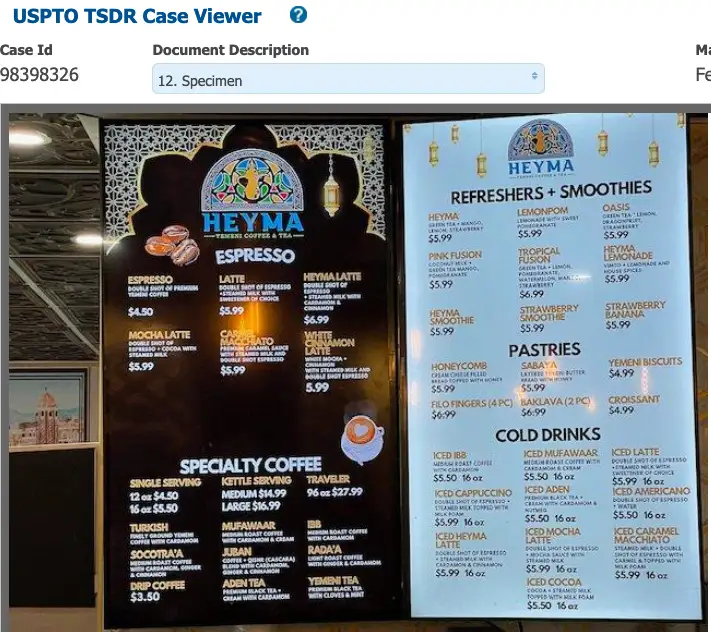
Photo of interior signage showing use of the trademark HEYMA YEMINI COFFEE & TEA for restaurant services.
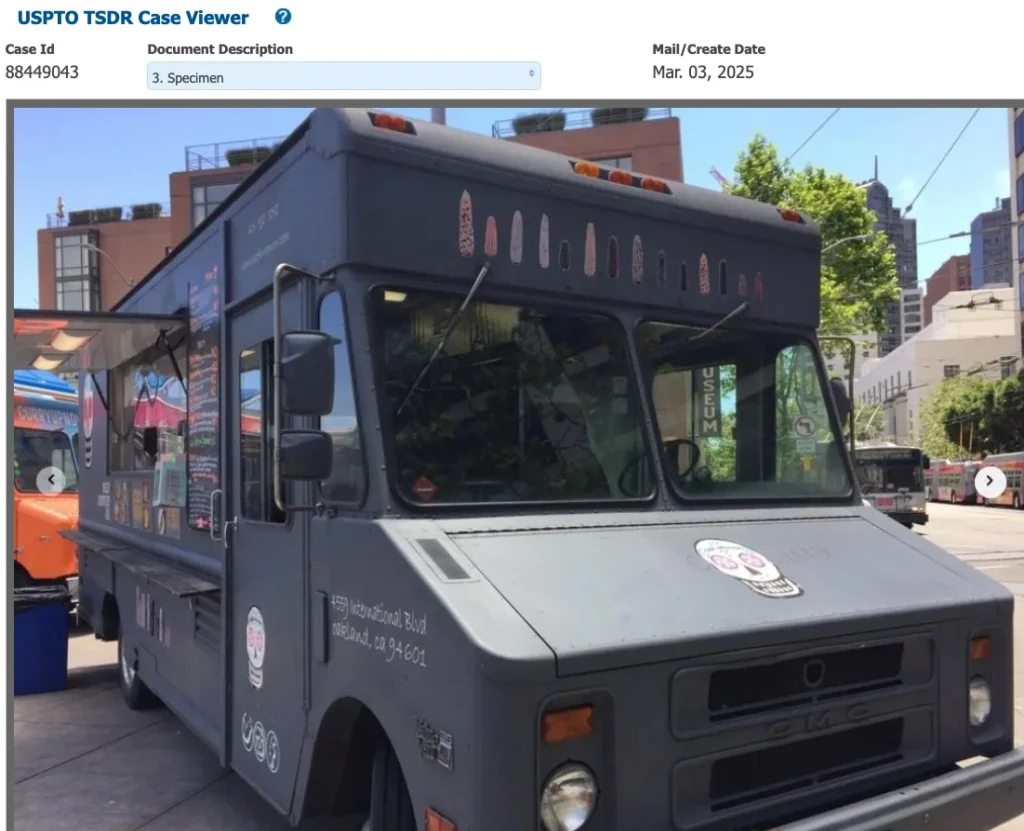
Photo showing the use of the trademark COOLINARIA and logo for food truck services.
Websites Offering Restaurant Services
Website screenshots are acceptable if they show:
- The trademark
- Description of restaurant services
- Hours of operation, online ordering, or reservation functionality
- Location information
A homepage without evidence of services may be insufficient.
Online Ordering Platforms (Restaurant-Owned)
If the restaurant operates its own ordering portal, screenshots that show:
- The mark
- Menu items
- Add-to-cart or order buttons
These can serve as strong proof of service use.
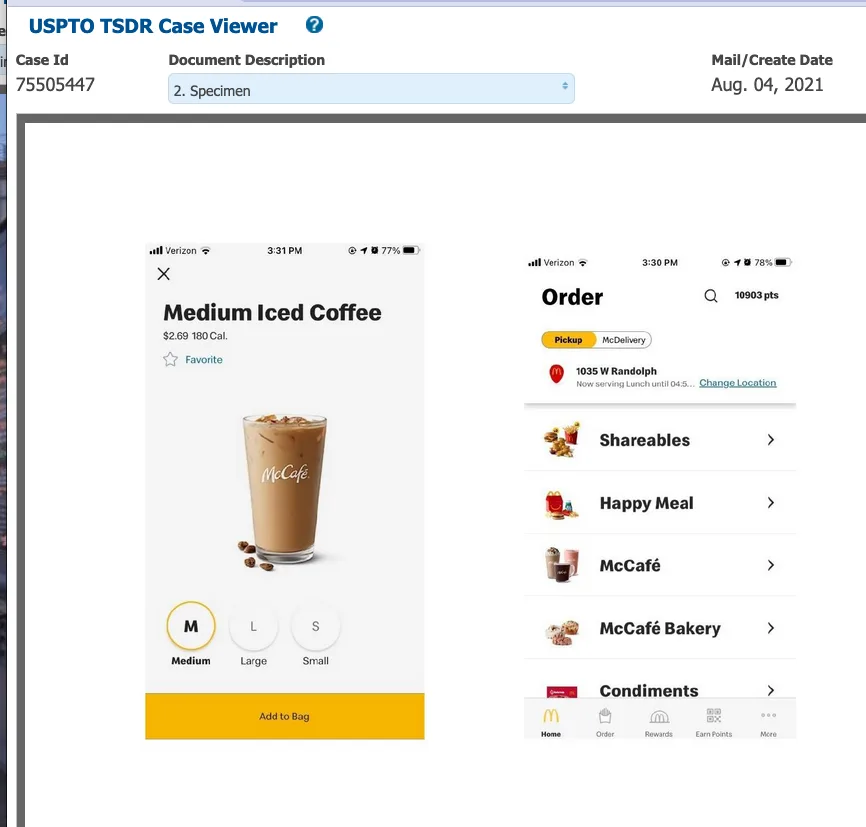
Screenshot showing the use of trademark McCAFE using an online portal for ordering.
Menus
Menus may also function as specimens if they:
- Display the restaurant name prominently
- Show the offering of food services
- Demonstrate active commercial operation
Digital or printed menus both qualify.
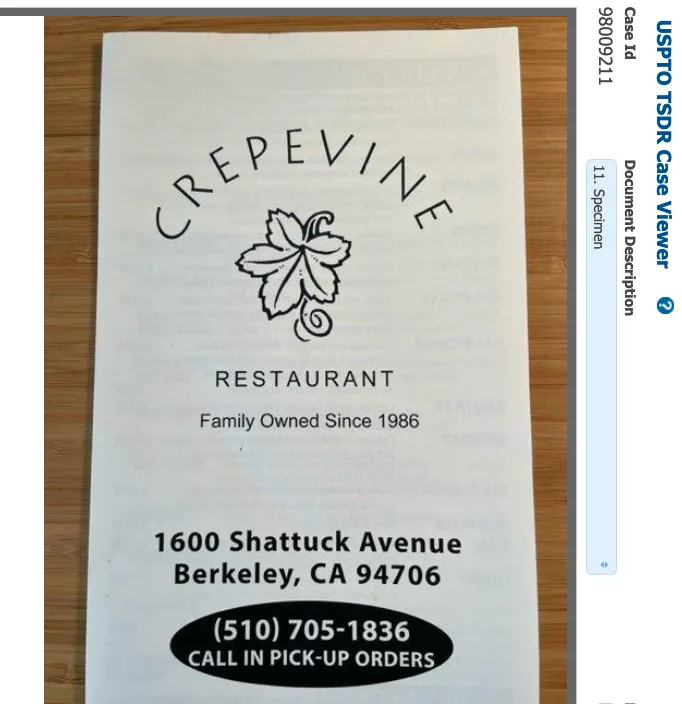
Photograph of the menu as evidence of use of the trademark CREPEVINE and logo.
Physical Location vs Online Ordering Proof
Modern restaurants often operate both:
- Physical dine-in locations
- Online ordering/delivery models
Both are acceptable forms of proof, but they must clearly show active service availability.
Physical Location Evidence
Strong examples:
- Photograph of storefront with signage
- Receipt showing the mark
- Interior menu board
The mark must be visible and clearly connected to the restaurant services.
Online-Only or Ghost Kitchens
For restaurants operating without a storefront:
- Website with an ordering system
- Delivery platform listings
- Active menu pages
These can qualify provided they show actual service operation.
Delivery Apps and Third-Party Platforms as Evidence
Many restaurants rely on platforms such as:
- DoorDash
- Uber Eats
- Grubhub
Are Third-Party Listings Acceptable?
Yes, but with caution.
Screenshots may qualify if they show:
- The restaurant name is clearly
- Menu items
- Ordering functionality
- Geographic availability
However:
- The listing must reflect the restaurant’s own service
- The mark must identify the source of services
- The page should show actual availability, not a placeholder
The USPTO sometimes questions third-party listings if they appear temporary or incomplete.
Best practice: combine delivery app evidence with your own website or menu specimen.
Difference Between Restaurant Name and Food Product Branding
This is where many restaurant owners make costly mistakes.
Restaurant Name (Service Mark – Class 043)
Example:
“Shish Grill” used to identify the restaurant business itself.
Acceptable evidence:
- Menu header
- Storefront sign
- Website homepage
- Delivery listing
This shows the mark identifies the restaurant service.
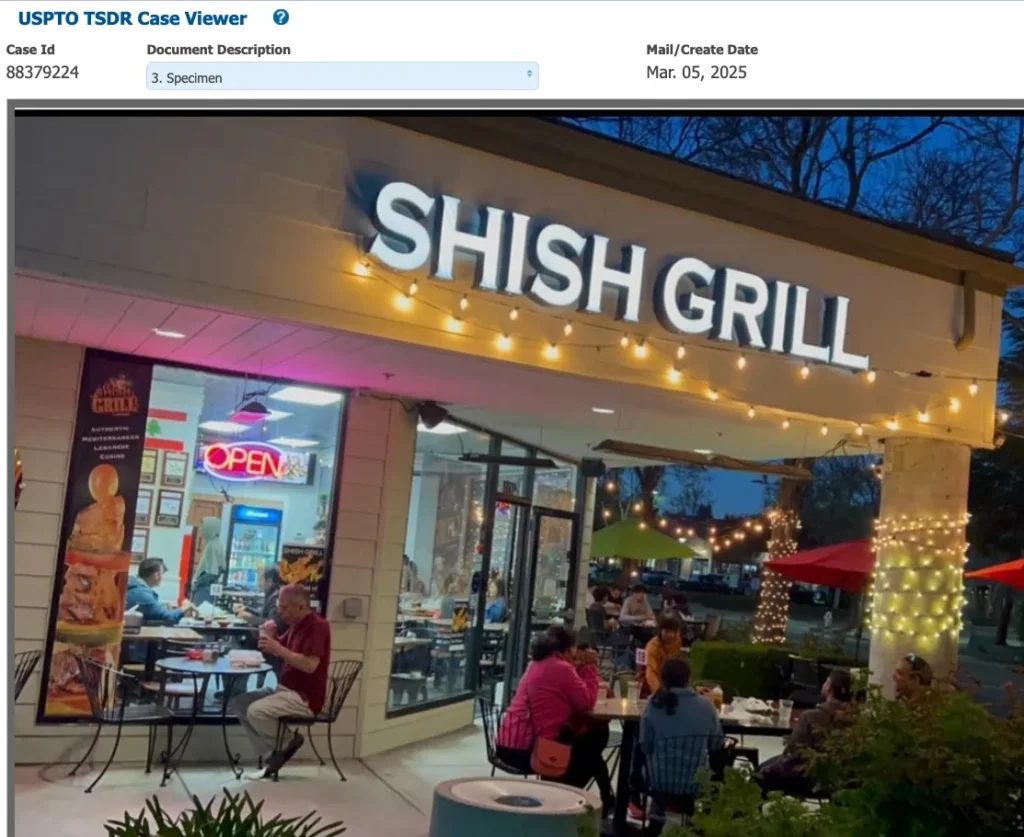
Photo of exterior signage showing the use of SHISH GRILL for restaurant services.
Food Product Branding (Trademark for Goods)
If a restaurant sells:
- Bottled sauces
- Packaged coffee
- Frozen meals
- Branded spice blends
Those items fall into separate goods classes, not Class 043.
In that case:
- You must file in the appropriate goods class
- You may provide product packaging specimens
- Menu listings may be sufficient under specific circumstances
Many restaurants submit menu photos to prove trademark use for packaged goods. That may be refused if the photo does not adequately show use of the trademark for the food item.
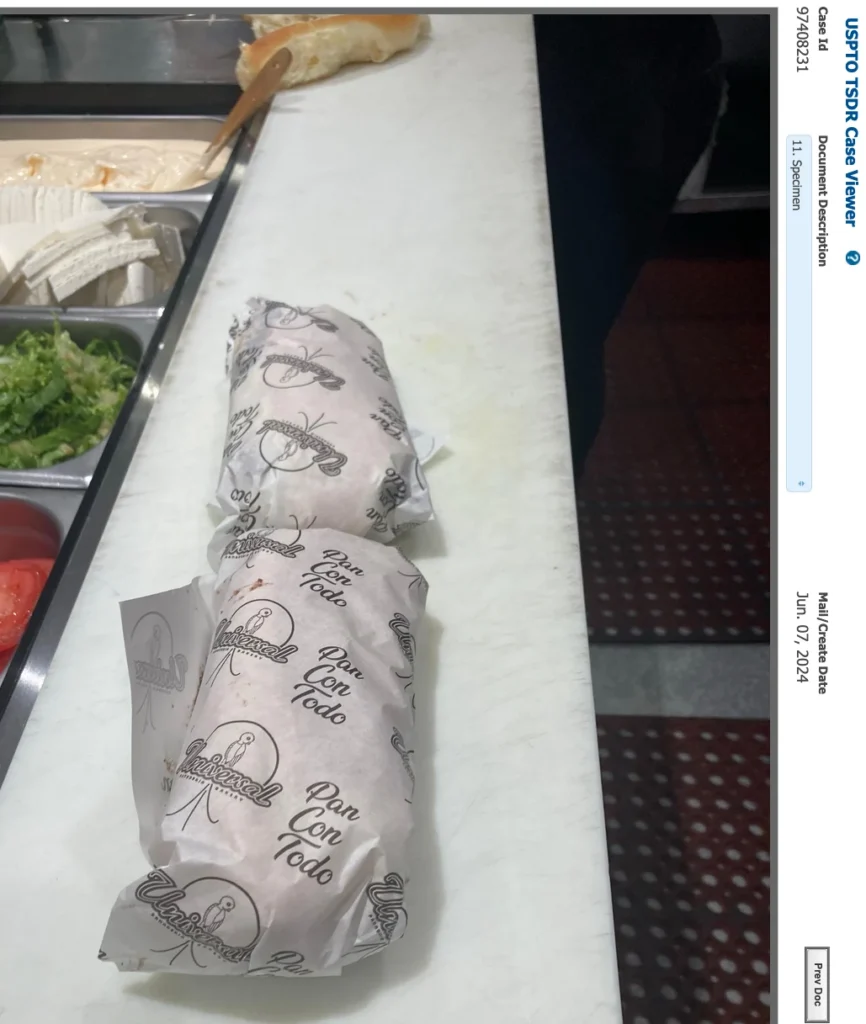
Photograph showing use of trademark for PAN CON TODO for sandwiches, in class 030.
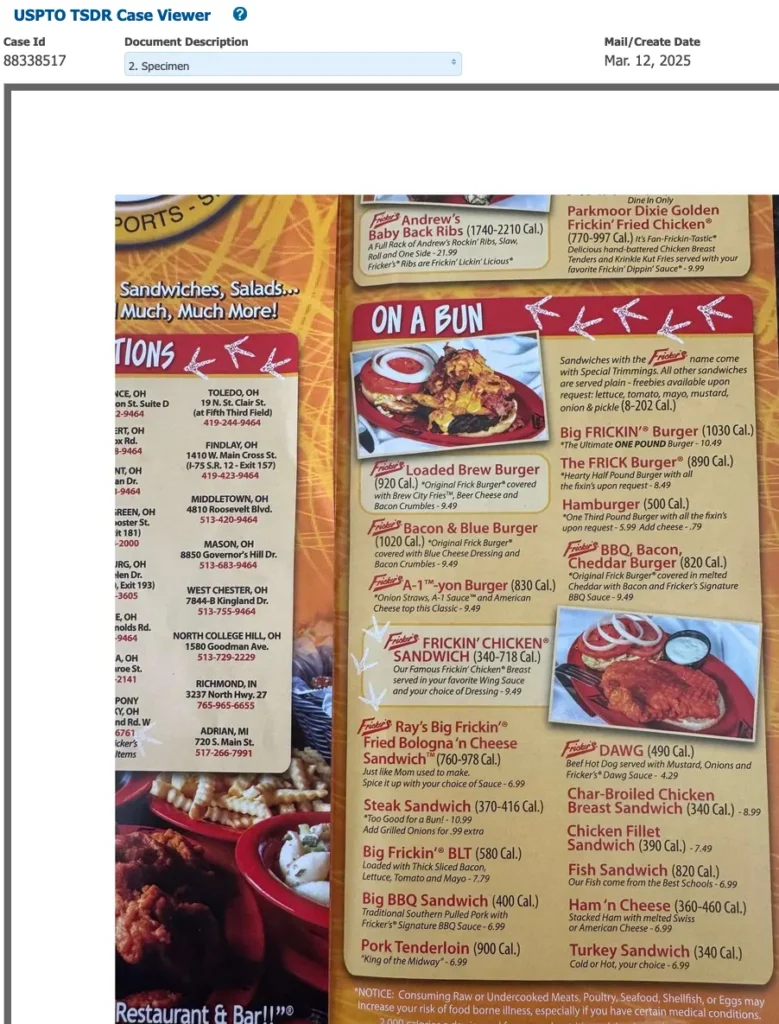
Specimen showing use of trademark for RAY’S BIG FRICKIN’ FRIED BOLOGNA ‘N CHEESE SANDWICH for menu item in the nature of sandwiches in Class 030.Common Specimen Mistakes in Restaurant Filings
Restaurant owners frequently receive Office Actions due to:
Submitting Advertising for a Future Restaurant
“Coming Soon” pages are not acceptable.
The service must be active.
Social Media Announcements Only
Instagram posts announcing your opening are generally insufficient unless they clearly show service availability.
Social Media Announcements Only
Instagram posts announcing your opening are generally insufficient unless they clearly show service availability.
Decorative Use of the Mark
If the mark appears only as:
- Wall art
- Decorative background
- Hashtag
and not as a source identifier, it may be rejected.
Submitting Food Photos Without Service Context
A plate of food with a small logo overlay is usually insufficient.
The specimen must show association with the restaurant service, not just food imagery.
Failing to Show Interstate Commerce
If your evidence appears strictly local and lacks indication of interstate commerce (e.g., online ordering across state lines), the USPTO may question use in commerce.
Failing to Show Interstate Commerce
Before submitting proof of use, confirm:
- The restaurant is actively operating
- The mark appears prominently
- The specimen shows restaurant services
- Online ordering (if applicable) is functional
- Screenshots include URL and date
- Evidence is not merely promotional
For related industry guidance, see: How to Show Trademark Use for Clothing Brands: Acceptable Specimen
Examples: Trademark Specimens for Software: Class 009 vs Class 042 Explained
Frequently Asked Questions
What class do restaurants or food trucks file under?
Restaurant and food trucks file under International Class 043 for restaurant services, catering services, or other services to provide food or drinks.
Is a menu an acceptable trademark specimen?
Yes. A menu displaying the restaurant name and offered services is one of way to prove the use of a trademark for restaurant services.
Can a website screenshot work as proof of use?
Yes, if it shows the mark and active restaurant services, such as ordering or reservations.
Are delivery app listings acceptable specimens?
They can be, if they clearly show the restaurant name, menu items, and active ordering functionality.
Is a storefront photo enough?
Yes, if it clearly displays the mark and indicates active restaurant services.
Check our LinkedIn and YouTube profiles for more information.
Can I use the same trademark for bottled sauce?
It is possible to use a trademark for both restaurant services and goods. However, the trademark application must include at least two classes: one for restaurant services and another for the physical goods. For example, a cafe may have a trademark in Class 043 for cafe services and also a trademark in Class 030 for coffee beans.
What happens if my specimen is rejected?
The USPTO may issue an Office Action requesting a substitute specimen or clarification.

“Disclaimer: This blog post is provided by Adams Law Office for educational and informational purposes only. It is intended to offer a general overview and understanding of trademark law and related topics, not specific legal advice. The content reflects the state of the law at the time it was written and may not reflect subsequent legal developments. This material should not be used as a substitute for professional legal counsel tailored to your individual situation. For personalized legal guidance, please consult a licensed attorney.”